


The Anniversary of the Royal Australian Navy
- Shaun Lewis
- Mar 23
- 3 min read

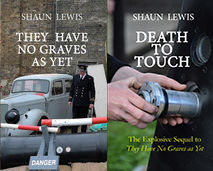
This weekend the Royal Australian Navy (RAN) celebrated in Sydney Harbour the 125th anniversary of its formation on 1 March 1901. Throughout its history there have been close bonds with the Royal Navy and the two navies fought together in both World Wars. In my WW1 submarine novel, The Custom of the Trade, I describe the operations of HMAS AE1 in the Dardanelles and I have based much of the first of my WW2 novels on WW2 mine disposal teams, They Have No Graves as Yet, on two Australians, namely, Hugh Syme GC GM and Bar, and John Mould GC GM. Coincidentally, this weekend was also, the anniversary of the birth of the latter on 21st March 1910.
Mould was born in Gosforth in 1910 and emigrated as a child to Australia. However, like many members of the Royal Australian Navy Volunteer Reserve, he volunteered to make the long sea voyage to Britain in late 1940 to serve with the RN. A small number, including Hugh Syme, were trained as Rendering Mines Safe (RMS) officers. Such officers had been recruited and trained in response to the Germans dropping on Britain’s cities by parachute huge mines containing a ton of explosive and designed to create terror and panic amongst the local population. When such mines were dropped in the vicinity of key installations such as railway junctions, armament factories or docks, they were considered Category ‘A’ incidents. RMS teams were ordered not to destroy such mines in situ in order not to destroy critical neighbouring infrastructure. Instead, pity the poor RMS officer tasked to defuze the mine and whose life was considered expendable! To add spice to the task, the mines were primed to self-destruct on land (ie explode) after 17 seconds. Were the RMS officer to hear the clockwork fuze to start, he had to run 400 metres to safety in those precious few seconds. Sadly, some didn’t manage it.
Such was the success of the various RMS teams in not just rendering these mines safe, but stripping them to learn their ingenious secrets, it didn’t take the Germans long to design ever sophisticated booby traps to prevent the mine being stripped or to kill the RMS teams to discourage such activities. It became a deadly cat and mouse game for the RMS teams and British scientists to stay one step ahead of the fiendish inventions of the Germans.
Like many RMS officers, Mould was sent all over the UK to deal with magnetic mines. He spent Christmas 1940 in Manchester and in January 1941 was sent to Cardiff. There he had an unfortunate reception from the locals. Unable to defuze a mine in a school yard next to the telephone exchange, he was instructed to ‘burn it’, ie burn off the explosive inside so that if the fuze detonated, the mine would cause less damage. Part way through the process, the mine exploded and not only nearly killed Mould, but destroyed the nearby buildings. He was warned by the Police to clear out quickly as an angry mob of residents was on its way to beat him up.
One of the Germans’ most ingenious inventions was the Type ‘G’ mine. It contained several secret devices and a fiendish booby trap to ensure the secrets were not discovered. Within the mine were light sensitive cells that would fire the mine if its insides were exposed to light. Mould was one of the first to defuze such a mine (unaware of the deadly, but thankfully for him, damaged booby trap) and as a result of his experience, such mines were thereafter always defuzed at night or using ultraviolet light in a tent. Mould was, also, one of the first RMS officers to be trained to work on mines underwater. By then, the Germans were deploying acoustic mines and the noise of a diver’s bubbles was enough to trigger them. Mould, thus, worked with scientists to trial and develop a diving suit with an integrated air supply system that would not release bubbles.
For all his valour and dedication, Mould was awarded the King’s Commendation for Brave Conduct, the George Medal and the George Cross. Sadly, and despite surviving so many near-death experiences during the war, he died at the age of 47 of peritonitis back in Australia.




Comments