


Without men like him, Britain might have lost WW2 in 1939!
- Shaun Lewis
- Feb 5
- 3 min read

John Bridge was born on 5 February 1915. At the outbreak of WW2, he was a school master teaching physics in Sheffield, but despite being a pacifist, he joined the Royal Naval Volunteer Reserve (RNVR). He was one of eight physics masters who volunteered for the Royal Navy's new Rendering Mines Safe (RMS) units. The Germans were dropping one-ton magnetic mines on Britain’s cities to create terror and destruction and the Admiralty needed brave men with scientific knowledge to overcome the mysteries of the mines’ electronic fuzes and booby traps. These mines had first been dropped in Britain’s coastal waters in September 1939 and they had created such havoc that Britain’s maritime trade was at a standstill. Battersea power station was running out of coal and the Admiralty were forced to warn Churchill that, without a counter-measure to the new mystery weapons, he would have to seek peace terms with Hitler within six weeks. Fortunately, four very brave men of an RMS unit risked their lives to uncover the mine’s secrets.
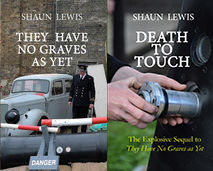
Bridge went on to rise to the rank of lieutenant commander and his calm courage and technical skill earned him the King’s Commendation for Bravery, the George Cross and two George Medals. This made him the Allies’ most decorated serviceman. His story was the inspiration for my two WW2 novels, They Have No Graves as Yet and Death To Touch (I am currently writing the final book of the trilogy).
As an example of Bridge’s courage, having already won the George Medal twice, in August 1943, he was sent to Sicily to clear the harbour of Messina of some ingenious and deadly mines and depth charges. Such was the intricacy of the booby traps, all members of the previous disposal team had been killed or wounded. Even so, the pressure was on to clear the harbour for the Allied landings on the Italian mainland. In anticipation of such a requirement, Bridge had taught himself to dive and personally led his team on 28 dives to discover the new type of booby trap and clear over 200 charges in time for the main assault on Italy. One of his dives lasted 20 hours. It was for his valour on this occasion that he was awarded the George Cross. Given that the Germans were still firing shells across the Strait of Messina during this operation, he might well have received the Victoria Cross.
Nonetheless, this was not the end to Bridge's distinguished war service and heroism, and he might have won many more awards for his gallantry. In September 1944, whilst clearing unexploded mines and bombs in the port of Antwerp, he was flown urgently to Nijmegen to deal with two mines resting against the major bridge crossing the river Waal. The charges had been laid by German frogmen to delay the Operation Market Garden convoys. Another had already brought down the railway bridge. Some people considered at the time that Bridge should have been awarded the Victoria Cross here, too, for successfully rendering safe the mines, since the advancing forces were under fire, or at least a bar to his George Cross, but according to Bridge, his commanding officer informed him, “I thought of recommending you for another gong, but you have had your quota.”
Despite being employed in the most hazardous of the Royal Navy’s units, Bridge survived the war and returned to working in education. He married, settled down in the Liverpool area and had a daughter, Sue Williams, who has given me much material and support in my writing of the three books her father’s deeds inspired.




Comments