


Commander Hugh Boyce DSC Royal Navy

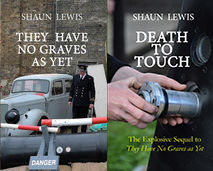
A few years ago, I approached Admiral of the Fleet Lord Michael Boyce to request he write a foreword for my second WW1 submarine novel, Where the Baltic Ice is Thin. When I was a junior officer on the staff of Captain Tenth Submarine Squadron, Lord Boyce was Captain Submarine Sea Training in the same building, so our paths crossed. Many years later, when I retired from the Royal Navy to join Goldman Sachs, our paths crossed once more when he was the Chief of Defence Staff and I poached his PA to become mine! His good-natured response was that he couldn’t compete with Goldman Sachs. However, perhaps, he never forgave me as he declined my request for a foreword (although he said he really liked the book). However, he was very interested in my declared intent to write a novel about the work of the Royal Navy’s Rendering Mines Safe teams. This book, They Have No Graves as Yet, fictionalises the truly heroic exploits of several officers who risked their lives to defuze some very advanced and deadly magnetic mines. Lord Boyce sent me some details of his father’s wartime service in the hope I might find them useful for my WW2 novels. His father, too, was a naval officer engaged in the business of sweeping for and defuzing German mines. I think my followers will find his story interesting.
Herbert (always known as Hugh) Boyce’s father had, also, served in the Royal Navy, but as a rating. Hugh was unable to follow his father into the RN since he suffered from asthma. Instead, he studied electrical engineering and after a few jobs in Britain, took a job with the Victoria Falls Power Company. When war was declared, he volunteered to join the Navy, but was refused permission as he was in a reserved occupation. However, in 1940, the Navy relented and Hugh joined the Royal Naval Reserve as an electrical officer.
He quickly specialised in electrical and magnetic mine sweeping and a year later was sent back to South Africa to the fitting out of a flotilla of minesweepers there and the training of their crews. After two years in Simons Town, he was appointed to Sheerness as the Senior Electrical Officer to the 120 minesweepers based there under the command of a Captain Hopper. The Sheerness Flotilla’s responsibility was to protect the coastal convoys by keeping the Channel free of mines.
In 1944, for the D-Day landings, Hopper’s minesweepers were in action off Arromanches’s Gold Beach and Hopper and Hugh moved to Normandy to oversee their fitting out and operations.
Once the Allies had established their bridgehead on the Normandy beaches, Hopper and Hugh returned to Sheerness. However, the Allied advance stalled through a lack of fuel and it became essential to clear the Scheldt of its many mines so that the Allies could make use of Antwerp for resupply. Hugh was despatched with great urgency to Ostend for a reconnaissance, during which he was fortunate to find some papers giving the disposition of the enemy minefields. Hopper then brought in 50 minesweepers to clear the mouth of the Scheldt. Under intense enemy fire, the flotilla cleared over 400 mines, many of which Hugh had to defuze personally. Eight minesweepers were sunk during the operation, but the flotilla were successful in opening up Antwerp in the autumn of 1944 for the resupply convoy. Hugh was awarded the Distinguished Service Cross for his contribution.
At the end of the war Hugh was onboard the flotilla’s headquarters ship sweeping mines off the coast of the Netherlands when the ship detonated an acoustic mine. The resulting explosion caused severe damage to the ship and many casualties. To prevent the ship sinking it fell to Hugh to go below to rig an emergency electrical supply whilst another ship took off the survivors and wounded.
After the war, the Navy offered Hugh a permanent commission in its new electrical branch and he was appointed to the Pacific Fleet. He retired from the RN as a commander in 1966 and died on the 60th anniversary of D-Day at the age of 92. He had three very eminent sons including Admiral of the Fleet Lord Boyce, the former Chief of Defence Staff; Sir Graham Boyce, a former ambassador in Egypt and Professor Philip Boyce, head of the department of psychological medicine at Sydney University.



Comments